Table of Contents:
-
Introduction
-
What Is Hands-On Learning and Why It Matters
-
How GD Goenka Implements Activity-Based Learning
-
Subjects Made Engaging Through Practical Work
-
Benefits of Experiential Learning for Primary Students
-
Encouraging Creativity, Exploration, and Teamwork
-
Why GD Goenka is the Best CBSE School in Lucknow
-
Conclusion
1. Introduction
Young children learn best through experience. That’s why at GD Goenka Public School, Lucknow, teaching in the primary years focuses on hands-on, activity-based learning. It’s not just about books—it’s about building understanding through doing, touching, exploring, and creating.
2. What Is Hands-On Learning and Why It Matters
Hands-on learning is an educational approach where students:
-
Interact directly with materials and concepts
-
Solve problems through trial and error
-
Use their senses to explore and understand
-
Engage in active, rather than passive, learning
This method builds stronger conceptual understanding, better memory retention, and a greater interest in learning.
3. How GD Goenka Implements Activity-Based Learning
In primary classes (I to V), GD Goenka teachers integrate:
-
Learning corners with puzzles, math manipulatives, and educational games
-
Science experiments using safe, simple materials
-
Art-infused lessons to explain abstract topics
-
Role plays, storytelling, and dramatisation
-
Interactive digital tools and smart boards
Every classroom is designed to be a space of discovery, not just instruction.
4. Subjects Made Engaging Through Practical Work
Examples of hands-on learning across subjects:
-
Math: Using beads, blocks, and shapes for counting, patterns, and measurement
-
EVS: Growing plants, observing the weather, model-making for water cycles
-
English: Role play to build communication skills, phonics with letter tiles
-
Art & Craft: Tied into festival celebrations, history, and story themes
-
Computers: Coding with visuals, basic keyboarding and design tools
These methods help students apply classroom learning to everyday life.
5. Benefits of Experiential Learning for Primary Students
This approach builds:
-
Curiosity and motivation to learn
-
Fine and gross motor coordination
-
Teamwork and social learning
-
Critical thinking and decision-making
-
Stronger academic performance through active engagement
It also boosts confidence, especially among shy or hesitant learners.
6. Encouraging Creativity, Exploration, and Teamwork
Hands-on learning at GD Goenka encourages:
-
Students to ask questions and test ideas
-
Collaborative group tasks where each child has a role
-
Cross-curricular projects that build real-world connections
-
Reflection and feedback, helping children learn from outcomes
This makes learning a joyful and meaningful experience every day.
7. Why GD Goenka is the Best CBSE School in Lucknow
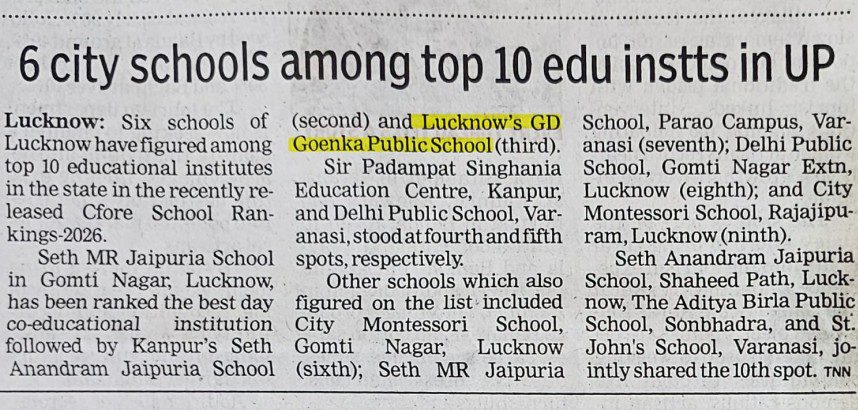
By making learning tangible, enjoyable, and effective, GD Goenka ensures that every student builds a strong academic foundation. Its hands-on, child-centered methods and modern infrastructure make it the best CBSE school in Lucknow for primary education.
8. Conclusion
At GD Goenka, classrooms are more than places to memorize facts—they are spaces where knowledge comes alive. With hands-on learning, students become active participants in their own education—building confidence, curiosity, and skills that last a lifetime.