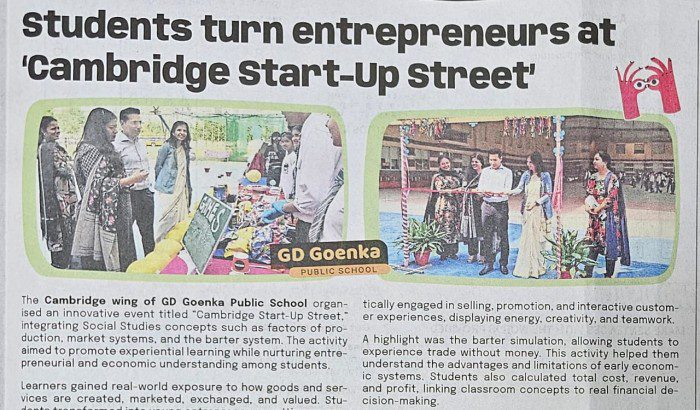
The Cambridge wing of GD Goenka Public School, Lucknow, organised an innovative and vibrant event titled “Cambridge Start-Up Street,” designed to nurture entrepreneurial thinking through hands-on learning. The initiative integrated Social Studies concepts such as factors of production, market systems, supply-demand connections, and barter-based economies, transforming theoretical lessons into a lively real-world experience for students. The event offered learners an exciting opportunity to understand how goods and services are produced, marketed, and sold, all within a simulated marketplace created entirely by the students.
Start-Up Street aimed to develop entrepreneurial confidence while strengthening economic literacy among learners. Students enthusiastically formed groups, planned their stalls, and created product ideas from scratch. They explored the complete journey of entrepreneurship—right from conceptualisation to production, pricing, branding, sales strategies, and customer interaction. With mock currency in use, the marketplace closely resembled a functional bazaar, allowing students to experience the flow of money, profit, and negotiation in a practical manner.
Each stall showcased creativity and originality. Students prepared items such as mini burgers, flavoured waffles, momos, pani puri, sandwiches, biscuit cakes, and sprout bowls. One of the key attractions was the “Make Your Bag” concept where young entrepreneurs customised bags with unique designs. Many items were infused with flavours, colours, or themes to captivate buyers. The stalls became hubs of activity as students promoted their products energetically, interacted with customers, and used persuasive communication techniques to enhance sales.
A major highlight of the event was the barter trade simulation, giving students firsthand experience of exchanging goods without money. Through this, they learned the practical advantages and limitations of barter systems, deepening their understanding of early economic practices. Students further calculated total investments, expenses, revenues, and profits—linking classroom concepts to financial decision-making.
The excitement reached its peak when students learned that the profits earned from the event would be donated to the Inayat Foundation, instilling values of compassion, charity, and community service. This blend of entrepreneurship with social responsibility made Start-Up Street not only educational but also emotionally meaningful.
The event successfully merged academics with practical exposure, emphasizing critical thinking, problem-solving, collaboration, leadership, and creativity. Parents, teachers, and guests appreciated the confidence with which students handled their stalls, negotiated prices, and presented their business ideas. The lively atmosphere reflected the learners’ enthusiasm and growing entrepreneurial spirit.
Principal Dr. Prerna Mitra and the Cambridge faculty congratulated the students for showcasing impressive innovation and teamwork. They highlighted that Start-Up Street mirrors the school’s vision of holistic education, promoting practical learning opportunities that help students develop essential life skills.

Cambridge Start-Up Street concluded on an inspiring note, leaving students with a sense of accomplishment and a deeper appreciation for the world of entrepreneurship. It proved to be a memorable and enriching experience—one that encouraged young minds to think boldly, work creatively, and embrace the possibilities of becoming future innovators and responsible contributors to society.